PUT YOUR FAMILY FIRST – DON’T LEAVE ANYONE BEHIND
Every parent understands, at a deep and instinctive level, that keeping a family safe is not a part-time responsibility. It is a constant, encompassing commitment that shapes decisions large and small — from what food goes on the table to what precautions are in place when something goes wrong. Most of us are diligent about the visible threats: we lock the doors, we install smoke detectors, we keep first-aid kits in the medicine cabinet. But there is one category of risk that high-rise families routinely underestimate, and it is also the one that carries the most catastrophic potential: the threat of fire in a tall building.
Why High-Rise Fire Risk Is Different
Living on the upper floors of an apartment building or condominium tower comes with genuine pleasures — panoramic views, distance from street noise, a sense of privacy and elevation that ground-floor living simply cannot offer. But it also comes with a risk profile that is fundamentally different from that of a suburban home or ground-floor apartment. Heat rises, smoke rises, and the escape routes that work perfectly well in a two-story house become dangerously unreliable in a twenty-story tower.
When fire breaks out in a high-rise building, stairwells rapidly fill with toxic smoke. Elevator shafts function as vertical chimneys, accelerating the spread of both heat and deadly gases to floors that may be nowhere near the origin of the fire. Residents on upper floors may find their primary escape routes compromised within minutes of an ignition they cannot even see yet. Understanding how fires spread in tall buildings is the first step toward understanding why a different kind of preparation is needed.
This is not a remote or theoretical concern. High-rise fires occur regularly in cities around the world, and the factors that determine who survives and who does not are almost always the same: those who had a plan and the equipment to execute it fare dramatically better than those who relied entirely on building infrastructure and emergency services.
Preparing Is the Ultimate Act of Family Care
There is a particular category of decision — rare, but profoundly impactful — that requires only a modest investment of time and money but pays dividends in peace of mind for years. Installing a reliable home security system is one of them. Updating your family’s emergency contacts is another. Securing a personal fire escape solution for every member of your household belongs in exactly that category.
We renew home insurance annually without much thought, because we understand that the consequences of not having it, while unlikely on any given day, are potentially devastating. A personal escape device for a high-rise family deserves the same clear-eyed calculation. The probability of needing it on any given night may be low. The consequences of needing it and not having it are permanent and irreversible. That asymmetry alone makes the decision straightforward for any parent who thinks it through carefully.
Creating a family-wide emergency plan — one that assigns specific roles, identifies the escape device, and practices the three-step deployment process — is one of the highest-value safety investments a high-rise family can make. The guide to creating a household emergency action plan walks families through exactly this process, from identifying risks to rehearsing responses.
The Limits of Relying on Emergency Services Alone
Fire departments are staffed by professionals of extraordinary courage and competence. Their record of saving lives under impossible conditions is one of the genuine achievements of modern urban infrastructure. But it would be neither fair nor accurate to suggest that complete reliance on fire services constitutes a complete safety plan for high-rise families.
Response times vary enormously based on city size, traffic conditions, and simultaneous demand on resources. In a major urban fire event involving multiple buildings or a large-scale emergency, fire department resources are stretched across competing priorities. Reaching the thirtieth floor of a burning building takes time — time that may not be available to a family trapped above the fire line. The responsible approach is to treat emergency services as a critically important backup, not as the primary line of defense. High-rise families need the ability to initiate their own safe evacuation without waiting for external rescue.
Understanding how to behave during a fire — including when to wait for rescue and when to self-evacuate — is knowledge that every high-rise resident should have before they ever need it. Similarly, knowing what the worst-case scenarios in a high-rise fire look like gives families the context they need to appreciate the importance of preparation.
How SkySaver Keeps Every Family Member Safe
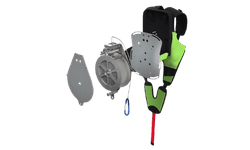
The SkySaver rescue backpack was designed from the ground up with high-rise families in mind. It is a Controlled Descent Device — a friction-based mechanism that allows any user, regardless of physical strength or prior training, to descend safely from any window above the ground floor. The same basic technology that professional climbers and window washers have relied on for decades has been re-engineered, simplified, and safety-certified for use by ordinary families in emergency situations.
Setup is a one-time process that takes minutes. A small anchor fitting is secured near a window — the structural point from which the descent cable operates. Each family member has their own backpack and harness, stored within easy reach of the designated window. In an emergency, the process is deliberately straightforward: buckle on the harness, clip the carabiner to the anchor, step out of the window, and descend. The braking mechanism controls speed automatically — there is no need to manage the rope manually or possess any particular physical capability.
Families with young children, elderly members, or individuals with limited mobility can all use SkySaver effectively. The system is scalable — each person descends independently using their own device, so no single individual carries the weight or responsibility of evacuating others. The entire family can be safely on the ground within minutes, without depending on a staircase that may be choked with smoke or a fire department that may still be en route.
Leaving No One Behind
The phrase “don’t leave anyone behind” captures something profound about family responsibility. In ordinary life, it means making sure everyone is fed, included, and cared for. In an emergency, it means having the equipment and the plan to get every person in your household out safely — regardless of what the stairwells look like or how long emergency services take to arrive.
SkySaver makes that level of preparedness accessible, affordable, and straightforward. It is not a luxury item for the overcautious — it is a practical tool for any family that takes their safety seriously and lives above the ground floor. The peace of mind that comes from knowing you have a reliable exit plan for every member of your family is something no amount of conventional safety equipment can fully replicate.
The time to prepare is before the emergency, not during it. Explore SkySaver products today and give your family the safety net they deserve.