The Terrifying Truth of How Fires Spread In Tall Buildings
Understanding how fire behaves inside a tall building is not merely academic — for the millions of people who live and work high above street level, it is information that can mean the difference between life and death. Most people dramatically underestimate how quickly a small flame can consume an entire floor, cut off escape routes, and transform a quiet evening into a catastrophic emergency. The facts are alarming, and grasping them is the foundation of any serious approach to high-rise safety.
The Speed of Fire: Why Every Second Counts
The single most dangerous misconception about fire is that it gives you time. It does not. Emergency preparedness authorities consistently find that the gap between a fire you could extinguish with a damp cloth and one that is entirely beyond control is often less than thirty seconds. In a modern high-rise apartment or office — packed with synthetic foam furniture, polyester fabrics, plastic fittings, and treated carpeting — that window is even narrower. Synthetic materials do not burn the way natural ones do; they melt, drip, and re-ignite, releasing intense heat and a torrent of toxic gases at speeds that natural materials cannot match. A minor kitchen ignition or electrical fault can engulf an entire room before most people have time to register that something is wrong.
Fire safety researchers describe a fire as roughly doubling in size every minute during its early stages. That exponential growth rate means that hesitation is not simply unwise — it is potentially fatal. Anyone who spots a fire after it has already been burning for thirty seconds is already facing an emergency that demands immediate, decisive action. There is no time for gathering valuables, no time for making phone calls, and no time for waiting to see if things improve.
Smoke: The Silent Killer in High-Rise Fires
By the sixty-second mark of a typical structure fire, smoke has become the dominant threat — and it is smoke, not direct flame contact, that accounts for the majority of fire-related fatalities. As smoke fills a room, it follows a predictable but lethal pattern: rising to the ceiling first, then spreading horizontally and descending toward the floor, eventually filling the entire space from top to bottom. Visibility collapses. Disorientation sets in within moments. Fire smoke is not simply hot air; it is a toxic mixture of carbon monoxide, hydrogen cyanide, acrolein, and particulate matter fine enough to penetrate deep into lung tissue. Even brief exposure can cause confusion and incapacitation, while prolonged inhalation is invariably fatal.
In a high-rise setting, smoke’s behavior becomes exponentially more dangerous due to a phenomenon called the stack effect. Warm air naturally rises through vertical shafts — stairwells, elevator corridors, and HVAC ductwork — carrying toxic smoke upward through the building far faster than fire itself travels. Residents on the twentieth floor may be breathing lethal concentrations of carbon monoxide before those on the fifth floor have smelled anything unusual. This counterintuitive dynamic is one of the most critical things to understand about fire in tall buildings. For a deeper look at how fires move through a building’s structure, the SkySaver guide to fire spread in high-rise buildings covers the mechanics in precise detail.
Lethal Heat and the Point of No Return
Within three minutes of ignition, air temperatures inside a burning room can reach 600 degrees Fahrenheit at eye level. At that temperature, a single breath causes immediate and severe damage to the respiratory tract. Skin exposed to radiant heat at this level sustains third-degree burns within seconds, even without direct flame contact. As heat rises through a building, upper-floor residents experience these temperature spikes earlier than those below — not because the fire is physically closer to them, but because heat naturally seeks the highest available point. There is no practical refuge inside a structure once temperatures escalate to this level.
The most catastrophic phase of any structure fire arrives at the four-to-five-minute mark, when flashover occurs. Every combustible surface in the affected space — walls, ceilings, furniture, carpeting — simultaneously reaches its ignition temperature and erupts in flame. The room transforms from dangerously hot to universally lethal in a fraction of a second. As detailed in the comprehensive overview of rollovers, flashovers, and backdrafts, flashover marks the absolute point of no return. After it occurs, survival for anyone still inside drops to near zero.
Why High-Rise Evacuation Is Uniquely Dangerous
The challenges of escaping a high-rise fire are fundamentally different from those in a single-family home, and most standard fire safety advice fails to adequately address them. The primary evacuation route in any multi-story building is the staircase — but during a fire, stairwells frequently fill with smoke, become structurally compromised, or are blocked by panicking occupants moving in conflicting directions. For residents on the twentieth, thirtieth, or fortieth floor, descending dozens of flights of stairs while toxic smoke rises from below is not a realistic option in many emergency scenarios.
Elevators are never a safe choice during a fire. Heat and smoke can compromise elevator mechanisms, cause doors to malfunction at wrong floors, and elevator shafts function as vertical chimneys that accelerate the spread of both smoke and lethal heat. Waiting for the fire department to reach upper floors is equally problematic — even in cities with world-class emergency response infrastructure, reaching the fortieth floor of a burning building takes time that survivors may not have. The high-rise fire evacuation guide explores each of these hazards in depth and explains why a personal escape device belongs in every high-rise resident’s emergency plan.
There is also the profound psychological challenge. Most people, when confronted with a fire emergency, instinctively do the wrong things — they hesitate, they return for belongings, they use routes already compromised by smoke. Understanding how to behave during a fire and having rehearsed those behaviors before an emergency strikes is what separates those who survive from those who do not. Panic is the enemy; preparation and practice are the antidote.
The SkySaver Solution for High-Rise Emergencies
The realities of high-rise fire spread — the speed, the smoke, the heat, the compromised escape routes — make one thing unmistakably clear: relying entirely on building infrastructure and emergency services is not a complete safety strategy. High-rise residents need a personal backup plan, and that plan needs to be simple enough to execute under extreme stress in the dark with limited visibility.
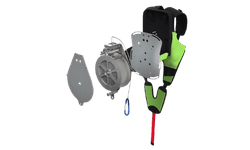
The SkySaver Controlled Descent Device was engineered specifically for this scenario. It is compact enough to store beside your bed in a purpose-built backpack, requires no specialist training to deploy, and is certified to both American and European safety standards. A small anchor fitting is installed near a window — a one-time process requiring no special tools. In an emergency, the backpack goes on, the harness clips to the anchor, and the occupant steps out of the window. The friction-based braking system controls descent automatically, lowering the user to the ground at a controlled, manageable speed. No strength required. No prior experience necessary. Children and elderly residents can be evacuated safely using the system.
SkySaver’s three-step process — buckle up, clip in, descend — is intentionally simple, because emergencies are not the time for complicated procedures. Fire moves faster than you expect, spreads wider than you imagine, and leaves less time to act than any other common emergency scenario. The science is clear, the danger is real, and the solution exists. The only remaining variable is whether you choose to prepare before the alarm sounds. Explore SkySaver products today and take the first step toward genuine high-rise safety for yourself and your family.