Evacuating a high-rise building during an emergency is a fundamentally different challenge from leaving a two-story house or a low-rise office. The sheer vertical distance involved, combined with the large number of occupants attempting to use a limited number of stairwells simultaneously, creates dynamics that can turn an orderly evacuation into a dangerous, life-threatening bottleneck. Anyone who lives or works above the ground floor of a tall building owes it to themselves to understand what high-rise evacuation actually involves — and what the available options are when standard routes become compromised.
How High-Rise Evacuation Differs from Standard Buildings

The defining characteristic of high-rise evacuation is the accumulation of vertical distance. In a standard fire evacuation from a two- or three-story building, every occupant reaches the ground within a minute or two of leaving their floor. In a fifty-story tower with hundreds of occupants on each floor, the mathematics are radically different. The stairwells become congested, movement slows to a crawl, and the total time required for a complete building evacuation can extend to two hours or more in large structures.
Historical examples illustrate both the scale of the challenge and what is achievable when systems function well. Following the 1993 World Trade Center bombing, tens of thousands of occupants successfully evacuated from two of the tallest office towers in the world, collectively traversing approximately five million individual stair flights in an organized, if exhausting, process. That event demonstrated that mass high-rise evacuation is possible — but it also revealed the physical demands, psychological stress, and coordination requirements involved when things go relatively well. When fire is actively spreading through a building and conditions in stairwells are deteriorating, the challenge becomes exponentially more severe.
Understanding how fire spreads through a high-rise is essential background for appreciating why conventional stairwell evacuation can become dangerous or impossible. Smoke rises faster than occupants can descend. Heat builds in enclosed vertical spaces. And the physical difficulty of descending dozens of floors under stress, in poor visibility, while breathing contaminated air, significantly impairs even physically capable adults.
Understanding Emergency Communication During an Evacuation

One of the most important — and least understood — aspects of high-rise evacuation is that modern buildings are not designed for universal simultaneous evacuation in most fire scenarios. Building codes for high-rise structures typically incorporate a phased evacuation approach, in which only the floors immediately affected by fire and those directly adjacent are initially directed to evacuate. Other floors may be instructed to shelter in place or await further direction from building management systems.
This approach is supported by the fire-resistant compartmentalization built into modern high-rise construction — reinforced concrete floors, fire-rated corridor doors, and pressurized stairwells designed to keep smoke out. These features are intended to contain a fire long enough for targeted evacuation and firefighting operations to occur. High-rise buildings are required to have emergency voice communication systems capable of issuing floor-specific instructions, and in well-managed emergencies, these systems provide crucial real-time guidance to occupants.
The practical implication is that high-rise residents should know their building’s specific evacuation plan in advance, including the location of all stairwells, the designated assembly point, and whether phased evacuation procedures are in place. This information should come directly from building management and should be reviewed at least annually. Developing a personalized household emergency action plan that incorporates these building-specific details is a critical preparedness step.
When Standard Evacuation Routes Fail

Even well-designed buildings with excellent safety systems can present situations where standard evacuation routes become untenable. Stairwells can fill with smoke from lower floors, structural events can block corridors, and mass panic can create dangerous crowd dynamics in enclosed spaces. Elevators are never a safe option during a fire — their mechanical systems are susceptible to heat and smoke damage, their shafts function as vertical chimneys, and numerous fire fatalities have occurred among people waiting for or riding elevators during emergencies.
In some building configurations, roof access provides an evacuation option — helicopter rescue from rooftops has been successfully employed in high-rise fire events, and it remains a possibility in certain scenarios where buildings are accessible from above. Safe refuge areas, mandated in some building codes, provide hardened spaces where mobility-impaired occupants or those unable to descend stairs can await fire department rescue. These are valuable resources but not universal solutions.
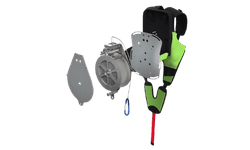
For residents above the reach of fire department aerial ladders — typically above the seventh or eighth floor — there is one personal evacuation option that does not depend on building infrastructure or external rescue: a controlled descent device. The SkySaver rescue backpack provides exactly this capability. When stairwells are compromised and waiting is not safe, SkySaver allows any resident to clip onto a pre-installed window anchor and descend to the ground under friction-controlled, automatic braking — no specialist skill required, no physical strength demanded, and no dependence on systems that may already have failed.
Practical Steps Every High-Rise Resident Should Take
Effective high-rise evacuation preparedness involves both knowledge and equipment. On the knowledge side: learn your building’s evacuation plan, know the location of all stairwells on your floor, never use elevators during any fire emergency, and stay informed about building-wide communication systems. Know how to behave during a fire — the behavioral decisions made in the first sixty seconds of a fire emergency are often the most consequential ones. For families, the principle of leaving no one behind demands that every family member knows their role in the evacuation plan before any emergency occurs.
On the equipment side: ensure functioning smoke detectors are installed, maintain a fire extinguisher for early-stage intervention, and install a SkySaver rescue device near a window for every member of your household. The combination of knowledge and equipment is the only preparation that covers the full spectrum of scenarios a high-rise emergency can present.
Time is the critical variable in every high-rise fire. The less time you spend figuring out what to do, the more time you have to actually do it. Explore SkySaver products today and complete your high-rise evacuation preparedness plan with the personal escape device that works when everything else fails.