Home » WHAT IS A FIRE TORNADO? | SKYSAVER RESCUE BACKPACKS
WHAT IS A FIRE TORNADO? | SKYSAVER RESCUE BACKPACKS
When people talk about the most dramatic and terrifying forces that nature can produce, the conversation usually centers on hurricanes, earthquakes, or tornadoes. But few phenomena are as visually stunning and genuinely catastrophic as the fire tornado — a rare convergence of intense heat and turbulent wind that creates one of the most destructive phenomena on Earth. Known by several names including fire whirl, firenado, fire devil, and fire twister, this natural event is the kind of thing that seems pulled from the pages of science fiction but is entirely, terrifyingly real.
What Exactly Is a Fire Tornado?
A fire tornado forms when specific atmospheric conditions align with an active wildfire or large-scale firestorm. At its core, the phenomenon is driven by intense rising heat — hot air surges rapidly upward, creating a column of rotating air when combined with existing wind shear and turbulence. The result is a spinning vortex of flame that can reach temperatures of up to 2,000 degrees Fahrenheit (approximately 1,090 degrees Celsius). At those temperatures, nearly any material becomes fuel, and nearly any living thing caught within range faces catastrophic consequences.
The structure of a fire tornado typically consists of two components: a visible core of burning flame and an invisible rotating column of superheated air that extends above it. Most fire tornadoes are fueled by carbon-rich gases released by burning vegetation. These gases are drawn upward by the vortex and ignite when they reach the oxygen-rich upper core. The resulting column can generate winds exceeding 100 miles per hour in the largest examples — winds powerful enough to uproot trees, hurl burning debris across great distances, and sustain themselves far beyond the initial fire that spawned them.
Understanding what a fire tornado is and how it forms matters beyond scientific curiosity. It informs how communities in wildfire-prone regions prepare, how emergency responders approach large-scale fire events, and how individuals can recognize escalating danger in the wild.
The Three Types of Fire Tornadoes
Fire scientists have classified fire tornadoes into three distinct types based on their location relative to a burning area and their behavioral stability. A Type 1 fire tornado is stable in nature and forms directly over the burning area itself, anchored by the intense heat rising from the fuel below it. This type, while alarming, tends to remain relatively stationary. A Type 2 fire tornado forms downwind of the burning area and can be either stable or transient, meaning it may move unpredictably depending on shifting wind patterns. A Type 3 fire tornado is perhaps the most dangerous — it forms over an open area near an unevenly burning zone and is also either stable or transient, making its trajectory and intensity difficult to predict. The lack of predictability is what elevates the Type 3 classification from dangerous to catastrophic under the right conditions.
Historical Examples and Their Devastating Consequences
The historical record of fire tornadoes reads like a series of disaster case studies that underscore just how lethal this phenomenon can be. Perhaps the most staggering example in recorded history occurred during the 1923 Great Kanto Earthquake in Japan. The earthquake itself was devastating, but what followed transformed a natural disaster into one of the deadliest events of the twentieth century. A city-sized firestorm ignited across the urban landscape, and from within that inferno, a massive fire tornado — believed to be a Type 3 fire whirl — emerged. In just fifteen minutes, it killed an estimated 38,000 people. The speed and ferocity of that death toll illustrates why fire tornadoes occupy a category of danger entirely their own.
More recently, the 2018 Carr Fire in Northern California produced a fire tornado that was later classified by the National Weather Service as having the intensity of an EF-3 tornado. It generated wind speeds of over 140 miles per hour and left a trail of destruction through residential neighborhoods. Fire investigators noted that this was one of the first documented cases in the United States of a fire-generated atmospheric vortex strong enough to receive an official tornado rating — a sobering benchmark. Understanding the world’s worst wildfires and the conditions that produce events like fire tornadoes is essential context for anyone living in fire-prone regions.
Size, Duration, and Why They Cannot Be Directly Extinguished
The scale of fire tornadoes varies considerably. Most fall within a range of 30 to 200 feet in height — roughly 10 to 50 meters — though the largest documented examples have exceeded half a mile in vertical extent. Their duration can range from a few minutes to well over an hour, and they are sustained entirely by the fuel and atmospheric conditions around them. This is a critical point: fire tornadoes cannot be directly extinguished by any firefighting technique currently available. They can only be deprived of fuel and favorable conditions, which means that the primary emergency response is evacuation and containment, not suppression.
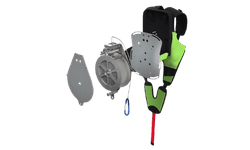
This inability to directly fight a fire tornado reinforces the broader lesson that when fire reaches a certain scale and intensity, human intervention shifts from control to survival. The same principle applies to ordinary structure fires that exceed what occupants can safely manage — at some point, the only right action is to leave. For residents of high-rise buildings facing fire conditions below or around them, the SkySaver rescue backpack provides a controlled descent solution that allows self-evacuation from an upper-floor window at a safe, regulated speed. While fire tornadoes are a wilderness and large-scale urban phenomenon, the lesson they teach about the speed and unpredictability of fire applies just as powerfully to everyday fire safety preparedness.
What Fire Tornadoes Teach Us About Fire Safety Preparedness
Even if the statistical likelihood of encountering a fire tornado during your lifetime is low, studying this phenomenon illuminates important truths about fire behavior in general. Fire is not a passive, predictable force — it is dynamic, responsive to environmental conditions, and capable of producing emergent behavior that catches even experienced observers off guard. Understanding how fires spread in any context, whether in a high-rise building or across an open landscape, is foundational to making good decisions when the situation deteriorates.
Preparedness at every level — individual, family, community — begins with taking fire’s potential seriously. That means having an evacuation plan, understanding warning systems, knowing when to shelter in place versus when to run, and equipping yourself with the right tools for your specific living environment. For those in multi-story buildings, planning for worst-case scenarios is not pessimism — it is prudence. Fire tornadoes remind us that fire can exceed our expectations in dramatic and deadly ways. Let that reminder fuel better preparation rather than paralyze with fear.
If you live or work in an elevated building and want to ensure you have a genuine escape option when conventional routes are blocked, explore SkySaver’s range of rescue backpacks today. Designed and certified for real-world emergency use, SkySaver gives you and your family a way out — no matter how high up you are. Get yours today and take the most meaningful step in personal fire safety you can.