Home » THE WORST CASE SCENARIO | SKYSAVER RESCUE BACKPACKS
THE WORST CASE SCENARIO | SKYSAVER RESCUE BACKPACKS
There is a moment in every serious high-rise fire when the ordinary assumptions of safety — that someone will come, that there is always a way out, that the building will protect you — collapse. For residents caught above the reach of fire department ladders with their primary exits blocked by smoke and flame, that moment arrives with brutal speed. Understanding what that scenario looks like in precise detail, and what it demands of the people caught inside it, is not meant to frighten — it is meant to motivate preparation before it ever becomes necessary.
What the Data Tells Us About Fire Department Response
Fire departments are staffed by professionals of extraordinary skill and courage, and their record of saving lives under dangerous conditions is remarkable. But they are not teleporters, and they cannot defy physics. The average fire department response time in major urban areas ranges from four to eight minutes from the moment a call is received — and that clock does not start until someone dials emergency services. If a smoke detector alerts a sleeping resident at 2:00 AM and the resident takes ninety seconds to assess the situation and make the call, the first fire unit arrives no earlier than five and a half minutes after the fire has already been burning and spreading.
Beyond response time, there is the physical limitation of ladder reach. The aerial ladders used by most fire departments can reach floors seven or eight in most standard configurations. A resident on the twelfth floor, the twentieth floor, or the fortieth floor is simply beyond the reach of external ladder rescue in virtually any practical scenario. Firefighters must enter the building, navigate smoke-filled stairwells, and ascend on foot — a process that, for upper floors of a tall building, adds additional critical minutes to an already compressed timeline. Understanding how rapidly fire spreads through a high-rise makes the arithmetic of response time deeply sobering.
A Scenario That Is Not Fiction
Consider a sequence of events that is entirely ordinary until it is not. A resident begins cooking dinner and steps away from the stove to take a phone call. The conversation extends longer than intended. Fifteen minutes pass. The smoke alarm activates. Returning to the kitchen, the resident finds the room already filling with flame — a fire that began on the stovetop has spread to the cabinetry and curtains. The fire extinguisher mounted in the kitchen is inaccessible; the heat near it is already intense enough to prevent safe approach.
The resident retreats to an interior room, closes the door, and calls emergency services. Smoke begins seeping under the door within sixty seconds. The temperature in the room rises steadily. The resident stays low, as they remember being advised. Three minutes have passed since the alarm. The fire department has been dispatched but has not yet arrived. The resident is on the twelfth floor. The ladder cannot reach them. By the time firefighters have ascended through the building, conditions in the room have deteriorated to a critical level.
This is not a fictional dramatization designed to alarm. It is a composite of events that have unfolded in high-rise fires documented by fire investigation units in cities around the world. The variables change — floor number, building layout, proximity of the nearest fire station — but the fundamental dynamic does not: fire moves faster than most people expect, it cuts off escape routes faster than most people believe possible, and the window for self-rescue closes long before external help can reliably arrive. The documented speed at which fire spreads should be part of every high-rise resident’s baseline knowledge.
Why Conventional Safety Measures Are Necessary but Insufficient
Smoke detectors are essential — they provide the warning time that makes all other actions possible, and no high-rise home should be without them. Fire extinguishers are valuable for early-stage intervention before a fire grows beyond the ability of an untrained person to fight it. Building sprinkler systems, where installed and properly maintained, can slow fire spread significantly. None of these measures, however, addresses the scenario in which the fire has grown beyond control and conventional exit routes are compromised.
That gap — the space between what standard safety equipment provides and what a resident trapped above ladder reach actually needs — is precisely what SkySaver was designed to fill. SkySaver is a Controlled Descent Device that allows any resident to descend safely from any window above ground level, without requiring physical strength, prior training, or favorable stairwell conditions. It is the emergency measure that works when all others have been exhausted.
Maintaining Composure When It Matters Most
The single most dangerous response to a fire emergency is panic. Panic causes people to make decisions that worsen their situation — to open hot doors, to use elevators, to freeze in place while conditions deteriorate around them. Preparation is the antidote to panic. When a person has a plan, has rehearsed what they will do, and has the equipment necessary to execute that plan, their capacity to act calmly and effectively under pressure is dramatically higher than that of someone facing the same emergency without any of those elements.
Developing an emergency action plan for your household is a specific, practical step that transforms abstract fire safety awareness into actionable procedure. Knowing how to maintain composure during an emergency and having rehearsed the correct behaviors turns a potentially paralyzing crisis into a sequence of executable steps.
The Difference Between the Prepared and the Unprepared
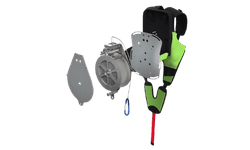
In the worst-case scenario — trapped above ladder reach with exits blocked — the difference between survival and tragedy frequently comes down to whether a resident has a personal escape device installed and accessible. The SkySaver rescue backpack addresses this scenario directly. Setup is a one-time process involving a small anchor fitting near a window. In an emergency, the harness is buckled on, the carabiner clipped to the anchor, and the resident descends in a controlled, friction-regulated manner. It takes seconds to initiate. It requires no prior experience. It works for any member of a household, including children and elderly residents.
No single precaution eliminates all risk. But the resident who has a smoke detector, a fire extinguisher, a household emergency plan, and a SkySaver rescue device has addressed the full spectrum of fire scenarios — from early intervention to worst-case evacuation. That is what comprehensive fire safety preparedness looks like in a high-rise context. Explore SkySaver products today and ensure your family is prepared for the scenario you hope never happens but cannot afford to ignore.