Most fire safety advice focuses on what to do when you are above the fire — how to descend through stairwells, when to shelter in place, and how to signal for rescue from upper floors. But there is a scenario that receives far less attention and is equally dangerous: being trapped below the fire in a high-rise building. When the fire is on a floor above you and burning materials, superheated gases, and water from firefighting operations are cascading downward, the rules of survival change in ways that most residents have never considered.
Understanding this scenario is not about creating fear. It is about closing a critical gap in most people’s emergency preparedness. Fires do not always start below you. They can ignite on any floor, and the effects of a fire above your position — falling debris, water damage, toxic smoke traveling downward through elevator shafts and utility channels, and structural compromise — present unique and serious threats that demand a specific response.
How a Fire Above You Creates Danger Below
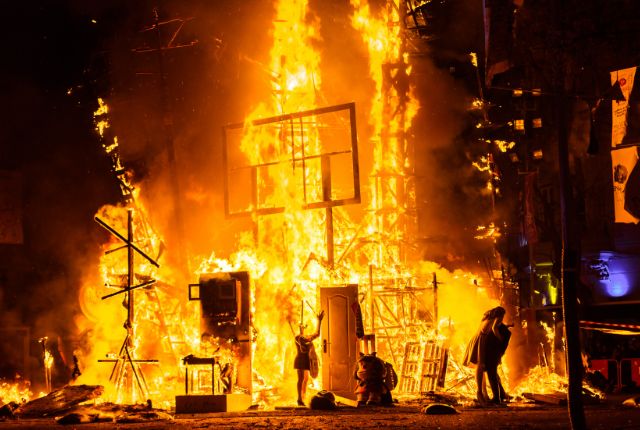
When a fire burns on an upper floor, several hazards can affect residents on lower floors. The most immediate is smoke migration. While the natural tendency of hot smoke is to rise, high-rise buildings are complex environments where air pressure differentials, HVAC systems, and the stack effect can push smoke in unexpected directions — including downward through elevator shafts, garbage chutes, utility risers, and stairwell doors that are propped open or fail to seal properly.
Water from sprinkler activation and firefighting hoses on the fire floor will flow downward by gravity, potentially flooding lower floors, damaging electrical systems, and creating slip hazards in corridors and stairwells. In severe fires, structural elements from the fire floor — including concrete, glass, and building materials — can fall through compromised floor assemblies or exterior cladding, creating hazards for anyone on the floors below or at ground level outside the building.
Perhaps most critically, a fire above your position can compromise the structural integrity of the floors between you and the fire. While modern high-rise buildings are designed to contain fires and maintain structural stability, no design is fail-proof. Understanding how fires spread in tall buildings — including vertically, horizontally, and through concealed spaces — is essential knowledge for every high-rise resident.
The Elevator Shaft: A Vertical Highway for Smoke
Elevator shafts are among the most efficient pathways for smoke to travel through a high-rise building. A fire on an upper floor can push enormous volumes of toxic smoke into the elevator shaft, where it can descend to lower floors and even reach the lobby level. This is one of the many reasons why elevators must never be used during a fire — but it also explains why lower-floor residents may encounter smoke in their hallways even when the fire is many stories above them. The lobby and lower floors of a building can become smoke-filled environments even when the fire itself is on the thirtieth floor.
What to Do When the Fire Is Above You
If you are in a high-rise building and learn that a fire has broken out on a floor above yours, your immediate response depends on several factors: the location of the fire relative to your floor, the condition of the stairwells, and the instructions being given by the building’s fire alarm system or emergency personnel.
In many cases, the safest initial action is to evacuate downward through the stairwell farthest from the fire’s location. Unlike the scenario of being above a fire — where descending through smoke can be fatal — evacuating downward from below the fire generally means moving away from the primary smoke and heat zone. However, this is only true if the stairwells are clear. Before entering any stairwell, check for smoke by feeling the door and looking for visible smoke around the frame. If the stairwell is smoke-free, proceed downward calmly and steadily.
If the stairwells are compromised — filled with smoke, water, or debris from the fire above — do not attempt to force your way through. Return to your apartment, close and seal the door using wet towels or tape, move to a room with a window, and signal your location to rescuers. Call emergency services immediately and inform them of your exact location and the conditions you are experiencing. Knowing how to behave during a fire includes knowing when to evacuate and when to shelter in place until help arrives.
The Risks of Staying Put Too Long
While sheltering in place can be the right decision when stairwells are impassable, it carries its own risks. Water from firefighting operations can flood your apartment from above. Smoke can eventually penetrate even well-sealed doors. And if the fire continues to grow, the structural risk increases with every passing hour. Sheltering in place should be viewed as a temporary measure while awaiting rescue — not as a long-term survival strategy.
Personal Evacuation Devices: Your Independent Exit Strategy
For residents on lower and mid-level floors, the scenario of being trapped below a fire presents a unique advantage that those above the fire do not have: the descent distance to the ground is shorter, and the conditions below your floor are typically clear. This makes personal descent devices an exceptionally effective option for evacuating when the fire is above you.
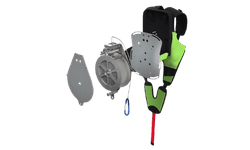
The SkySaver rescue backpack enables controlled descent from any window or balcony, allowing you to reach the ground safely without navigating smoke-filled corridors or compromised stairwells. The system is designed for anyone to use without prior training — three simple steps of buckle up, clip to the anchor, and descend bring you to safety in a matter of seconds. SkySaver devices are rated for the full height of the building they are installed in, so whether your apartment is on the fifth floor or the fiftieth, the device will deliver you safely to the ground.
SkySaver is certified by ASTM, ANSI, CE, TUV, and NFPA, and is insured by Lloyd’s of London. The SkySaver product range includes options for individuals, families, children, and pets — ensuring that every member of your household can evacuate independently, regardless of what is happening in the building above you.
Fire safety planning is most effective when it accounts for every possible scenario — not just the ones we are most accustomed to hearing about. Being trapped below a fire is a real risk in any high-rise building, and the residents who prepare for it will have options that others do not. Take the time today to understand this scenario, review your building’s emergency procedures, and equip your home with the tools that give your family the best chance of getting out safely, no matter where the fire starts.