Evacuating a high-rise building during a fire is one of the most challenging emergency scenarios that urban residents can face. Unlike single-story or low-rise buildings where evacuation is largely a matter of getting to ground level quickly, high-rise fires present a layered set of obstacles that can make even a well-rehearsed escape plan difficult to execute. Understanding these challenges in advance — before an emergency occurs — is the foundation of genuine preparedness for anyone who lives or works above the ground floor.
Why High-Rise Evacuation Is Different
The fundamental challenge of high-rise evacuation comes down to vertical distance. In a single-family home, a resident on the second floor is perhaps fifteen feet from the ground. In a modern high-rise, a resident on the 20th floor is more than two hundred feet above the street — a distance that cannot be covered on foot in anything less than several minutes even under ideal conditions. When those conditions are complicated by smoke, panic, crowds, and potentially compromised stairwells, the time required to reach safety increases dramatically.
Elevators are not an option during a fire. The heat from a fire can cause elevator systems to malfunction, cause doors to fail to close properly, and the shafts themselves act as vertical chimneys that accelerate the spread of both smoke and toxic gases. Firefighting doctrine universally prohibits the use of elevators during building fires, and residents who attempt to use elevators during an evacuation put themselves at serious additional risk.
Understanding Shelter-in-Place vs. Evacuate Decisions
One of the most important — and counterintuitive — aspects of high-rise fire response is that the correct decision is not always to evacuate immediately. In many high-rise fire scenarios, residents who are far from the floor of origin and in a building with effective compartmentalization may be safer sheltering in place than attempting to descend through smoke-filled stairwells. This is a significant departure from the instinct most people have, which is to get out of the building as quickly as possible.
The decision to shelter in place versus evacuate should be informed by building-specific fire response protocols, which responsible building management teams communicate to residents in advance. The general principle is: if you can smell smoke or see smoke under your door, and you cannot safely reach a stairwell, staying in your unit and sealing gaps under doors with towels may be safer than attempting to move through the building. As our dedicated article on whether everyone should evacuate a high-rise fire explores in depth, this decision depends on specific circumstances and cannot be reduced to a single rule.
When You Must Get Out
There are scenarios in which sheltering in place is not viable — when the fire is on or near your floor, when smoke is already present in your unit, or when the building’s fire suppression systems have failed to contain the spread. In these cases, evacuation is essential, and the approach matters enormously. Move immediately and decisively. Take only what you can carry in seconds. Close doors behind you — closed doors significantly slow the spread of fire and smoke, potentially protecting occupants in adjacent units.
In the stairwell, stay to the right to allow firefighters moving upward to pass on the left. Stay low if smoke is present. If a stairwell is blocked or heavily smoke-filled, retreat to a floor with cleaner air and reassess. Never attempt to descend through dense smoke — the loss of vision and cognitive function caused by smoke inhalation can be rapid and fatal.
Alternative Exit Strategies for High-Rise Residents
For residents whose primary stairwell exits are inaccessible, a window may be the only viable exit option. This is the scenario that personal controlled-descent devices are designed to address. Unlike a fire escape ladder — which is limited to the lowest floors — a controlled-descent device allows safe window-based evacuation from heights up to 25 stories. The device controls the descent automatically, requiring no training, no physical strength, and no prior experience.
Having this option available does not mean it should be the first choice — evacuation through a functional stairwell remains preferable when possible. But in the scenario where stairwells are blocked, smoke-filled, or otherwise inaccessible, a window exit combined with a controlled-descent device can be the difference between survival and catastrophe.
SkySaver: Your Personal High-Rise Escape Solution
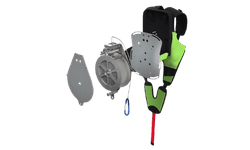
SkySaver‘s Controlled Descent Device is built specifically for the evacuation challenges of high-rise living. Stored in a compact backpack beside your bed or in your closet, it can be deployed in seconds: anchor to the fixed point near your window, put on the harness, and step out. The automatic braking system controls your descent to the ground at a safe, manageable pace.
No high-rise resident should rely solely on building systems and emergency services as their complete safety plan. Personal preparedness — including knowing your building’s evacuation protocols and having a personal escape option for the worst-case scenario — is the responsible complement to those systems. Explore SkySaver’s high-rise escape solutions and ensure your evacuation plan accounts for every possible scenario.